How to Master Platformer Games - Timing & Movement Guide 2025
Platformer games are all about precision, timing, and muscle memory. Whether you're playing Run 3, Vex, or Geometry Dash, mastering the core mechanics of jumping, landing, and movement control separates casual players from speedrunners.
This comprehensive guide reveals the fundamental techniques, advanced strategies, and practice routines that will transform your platforming skills from frustrating to flawless!
🎯 Understanding Platformer Physics
Core Mechanics Every Platformer Uses
The Jump Arc:
- Predictable parabolic curve
- Affected by initial velocity
- Gravity constant (usually)
- Landing point calculable
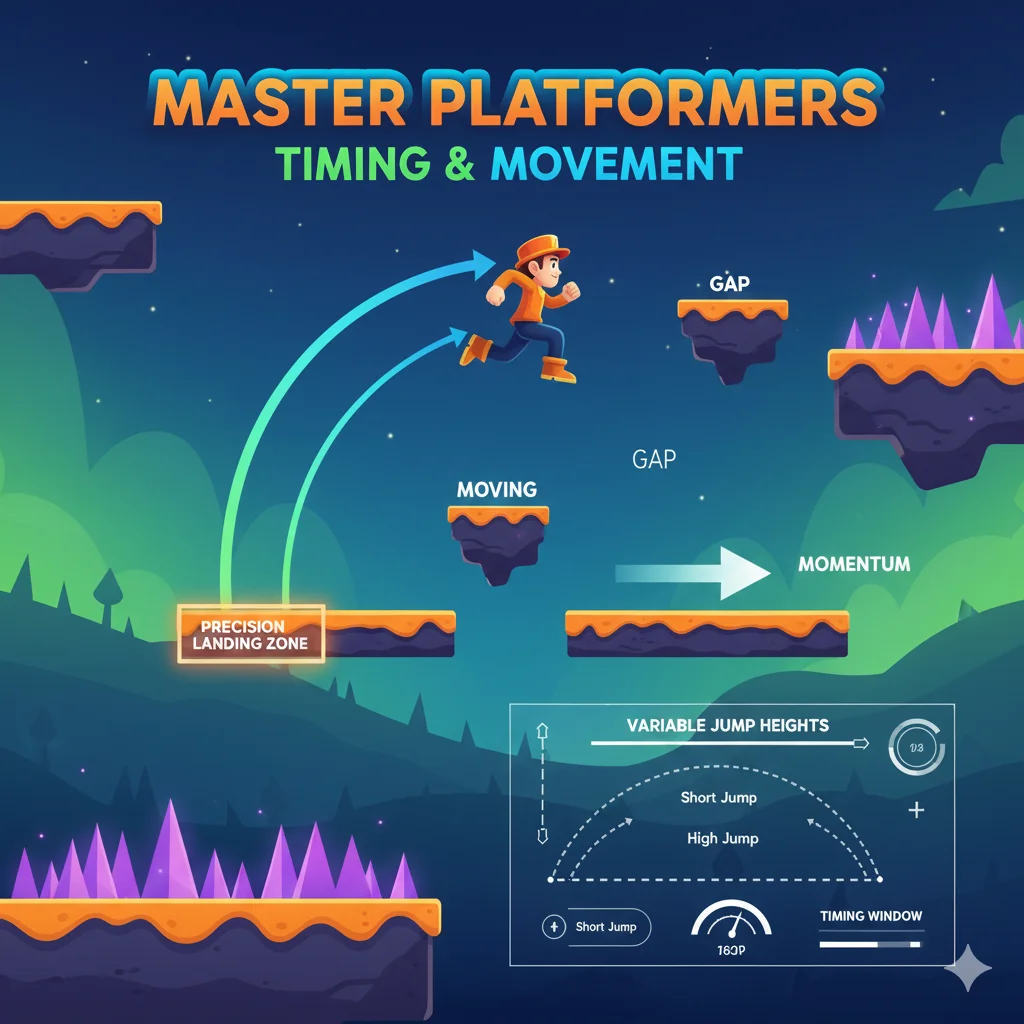
Variable Jump Height:
- Tap = short hop
- Hold = full jump
- Release timing controls height
- Most important mechanic to master
Momentum and Inertia:
- Running builds speed
- Jumping preserves momentum
- Landing affects next movement
- Slopes modify velocity
🎮 Essential Movement Techniques
1. Variable Jump Mastery
The Principle: Most platformers allow different jump heights based on button hold duration.
How to Practice:
- Find a safe area with no hazards
- Practice short hops - tap jump button
- Practice medium jumps - hold for 0.5 seconds
- Practice full jumps - hold until peak
- Mix randomly - build muscle memory
Precision Drill:
- Set up 3 platforms at different heights
- Jump to each using ONLY the necessary height
- No overshooting allowed
- Repeat until automatic
Why It Matters:
- Saves time (shorter jumps are faster)
- Avoids hazards (ceiling spikes, etc.)
- Enables tight sequences
- Fundamental to advanced play
2. Momentum Control
Understanding Momentum: Your character's speed affects jump distance and control.
Speed States:
- Stationary: Maximum control, minimum distance
- Walking: Balanced control and distance
- Running: Maximum distance, reduced control
- Sliding/Boosting: Fastest, least control
Momentum Techniques:
Building Speed:
- Run before jumps for distance
- Use slopes to accelerate
- Chain movements smoothly
- Maintain forward input
Killing Speed:
- Release movement keys mid-air
- Land and stop immediately
- Use opposite direction briefly
- Slide to controlled stop
Redirecting Momentum:
- Mid-air direction changes
- Wall bounces
- Slope redirects
- Platform edge pivots
3. Precision Landing
The Goal: Land exactly where you need to be for the next action.
Landing Zones:
Safe Landing:
- Center of platform
- Maximum margin for error
- Use when learning
Edge Landing:
- Very edge of platform
- Minimal distance covered
- Enables tighter sequences
- Requires practice
Running Landing:
- Land while maintaining speed
- No pause between actions
- For speedruns and flow
- Advanced technique
Practice Method:
- Pick a specific spot on a platform
- Jump from various distances
- Try to land on that exact spot
- Gradually make spot smaller
- Add movement after landing
4. Jump Timing Techniques
Coyote Time (Ledge Forgiveness): Many platformers give you a brief window (0.1-0.2s) after leaving a ledge where you can still jump.
How to Use:
- Walk off ledge confidently
- Jump slightly after leaving
- Feels more forgiving
- Prevents frustrating falls
Jump Buffering: Press jump slightly before landing, and you'll jump immediately upon touching ground.
Benefits:
- Faster sequences
- No input delay
- Maintains momentum
- Feels more responsive
Practice:
- Approach a gap at speed
- Press jump BEFORE reaching edge
- Character jumps at perfect moment
- Repeat until natural
🚀 Advanced Techniques
1. Wall Jumping
Basic Wall Jump:
- Touch wall while in air
- Press jump immediately
- Hold opposite direction
- Gain height and distance
Advanced Wall Jump:
- Wall Climb: Alternate wall jumps up vertical shaft
- Wall Boost: Use wall to change direction mid-air
- Wall Slide: Control descent speed on walls
Practice Routine:
- Find two parallel walls
- Climb using only wall jumps
- Time: 30 seconds
- Goal: Reach top consistently
2. Double Jump Optimization
When You Have Double Jump:
Conservative Use:
- Save second jump for emergencies
- Use first jump to assess
- Correct mistakes with second
- Beginner-friendly
Aggressive Use:
- Use both jumps for maximum distance
- First jump at edge
- Second jump at arc peak
- Speedrun technique
Combo Techniques:
- First jump + wall jump + second jump
- Massive vertical/horizontal distance
- Requires precise timing
- Practice in safe areas first
3. Dash and Boost Control
If Your Game Has Dash:
Dash Mechanics:
- Usually limited uses or cooldown
- Provides burst of speed/distance
- Often has invincibility frames
- Can change direction mid-air
Optimal Dash Usage:
- Horizontal: Maximum distance gaps
- Vertical: Reach high platforms
- Diagonal: Combine both benefits
- Defensive: Dodge hazards with i-frames
Dash Jump Combo:
- Dash in desired direction
- Jump at peak of dash
- Momentum carries you far
- Master this for huge skips
4. Rhythm and Flow
The Concept: Platformers have a rhythm - find it and you'll flow through levels.
Finding the Rhythm:
- Listen to music - often synced to gameplay
- Watch patterns - obstacles have timing
- Feel the beat - your inputs should be rhythmic
- Don't pause - hesitation breaks flow
Flow State Practice:
- Pick a level you know well
- Complete without stopping
- No pauses, no hesitation
- Pure muscle memory
- Time yourself
- Improve time gradually
💡 Training Routines
Beginner Routine (Week 1-2)
Day 1-3: Jump Control
- 10 min: Variable jump practice
- 10 min: Landing precision
- 10 min: Easy level completion
Day 4-7: Momentum
- 10 min: Speed control drills
- 10 min: Running jumps
- 10 min: Medium difficulty levels
Goals:
- Consistent jump heights
- Land where intended
- Complete levels without deaths
Intermediate Routine (Week 3-6)
Day 1-2: Advanced Jumps
- 15 min: Wall jump practice
- 15 min: Double jump optimization
Day 3-4: Timing
- 15 min: Coyote time practice
- 15 min: Jump buffering drills
Day 5-7: Application
- 30 min: Challenging levels
- Focus on techniques learned
Goals:
- Master wall jumping
- Consistent timing
- Complete hard levels
Advanced Routine (Week 7+)
Daily Focus:
- 10 min: Warm-up (easy levels)
- 20 min: Specific technique practice
- 20 min: Speedrun attempts
- 10 min: New level exploration
Weekly Goals:
- Improve personal bests
- Learn new skips/shortcuts
- Master one new technique
- Complete previously impossible levels
🎯 Game-Specific Tips
Run 3 (Gravity Platformer)
Unique Mechanics:
- Gravity changes based on surface
- 360-degree rotation
- Momentum in 3D space
Key Techniques:
- Plan rotations before jumping
- Use walls to change gravity
- Maintain orientation awareness
- Short jumps for precision
Vex Series (Parkour Platformer)
Unique Mechanics:
- Wall slides and climbs
- Precise hitboxes
- Instant death hazards
Key Techniques:
- Wall slide control - tap away to slow
- Edge grabs - position at ledge tops
- Hazard timing - memorize patterns
- Checkpoint strategy - know safe spots
Geometry Dash (Rhythm Platformer)
Unique Mechanics:
- One-button gameplay
- Rhythm-based timing
- Multiple game modes
Key Techniques:
- Listen to music - jumps sync to beat
- Memorize patterns - pure memory game
- Practice mode - use checkpoints
- Consistent timing - same rhythm every time
🚫 Common Mistakes to Avoid
1. Holding Jump Too Long
- Overshooting platforms
- Hitting ceiling hazards
- Wasting time in air
- Fix: Practice tap jumps
2. Rushing Without Learning
- Repeating same mistakes
- Not understanding patterns
- Frustration builds
- Fix: Slow down, observe first
3. Ignoring Momentum
- Awkward landings
- Missed jumps
- Inefficient movement
- Fix: Practice speed control
4. Poor Camera Awareness
- Not looking ahead
- Surprised by hazards
- Reactive instead of proactive
- Fix: Train eyes to scan forward
5. Inconsistent Inputs
- Different timing each attempt
- Can't build muscle memory
- Progress is slow
- Fix: Focus on consistency over speed
🎮 Practice Your Platforming Skills!
Apply these techniques to challenging platformer games!
Run 3
Master 3D gravity platforming
Vex 5
Perfect precision parkour
Geometry Dash
Rhythm-based timing challenge
📊 Progress Tracking
Metrics to Track
Completion Stats:
- Levels completed
- Deaths per level
- Time to complete
- Checkpoints used
Skill Metrics:
- Jump accuracy (%)
- Landing precision
- Sequence consistency
- Speedrun times
Weekly Goals:
- Complete X new levels
- Improve time on Y level
- Master Z technique
- Reduce deaths by N%
❓ Frequently Asked Questions
Q: How long does it take to master platformers?
A: Basic competence: 1-2 weeks. Advanced skills: 1-3 months. True mastery: 6+ months of dedicated practice.
Q: Are some people just naturally better?
A: Natural talent helps, but practice matters more. Most "talented" players simply practiced more effectively.
Q: Should I use keyboard or controller?
A: Personal preference. Keyboard offers precision, controller offers analog movement. Try both.
Q: How do I overcome frustrating levels?
A: Take breaks, practice specific sections, watch others, come back fresh.
Q: Is it worth learning speedrun techniques?
A: Yes! They improve general skills even if you don't speedrun.
Q: How important is frame rate?
A: Higher is better (60+ FPS ideal), but skill matters more than hardware.
Q: Should I use practice modes?
A: Absolutely! They let you focus on specific sections without repetition.
Q: How do pros stay so calm?
A: Experience, mindset training, and treating failures as learning opportunities.
🎯 Conclusion
Mastering platformer games is a journey of precision, patience, and practice. The techniques in this guide - from variable jumps to momentum control to advanced wall jumping - form the foundation of expert-level play.
Remember:
- Consistency beats speed
- Muscle memory takes time
- Every death teaches something
- Progress isn't always linear
- Have fun with the challenge!
Start today. Pick one technique, practice it for 15 minutes daily, and watch your skills transform. Then add another. Before you know it, levels that seemed impossible will feel effortless!
🎮 Ready to Level Up?
Apply These Techniques:
More Guides:
🎮 More Challenging Platformers!
Test your mastered skills on these brutal platformers!
The Impossible Quiz
Mind-bending platformer puzzles
Super Mario 63
Classic platforming perfected
N Game
Minimalist ninja platformer
Last Updated: December 6, 2025
Disclaimer: Game Duddles is an independent publication. We are not affiliated with the developers of the games covered. All game names, logos, and trademarks are property of their respective owners. This content is for informational and educational purposes only.